Restorative Justice : Chaos In The Classroom

The shift from Zero Tolerance to Restorative Justice (RJ) represents one of the most significant pivots in educational history. Pushing for Marxists “equity” has resulted in the violence we see in classrooms today and the #1 reason why teachers are quitting.
Timeline
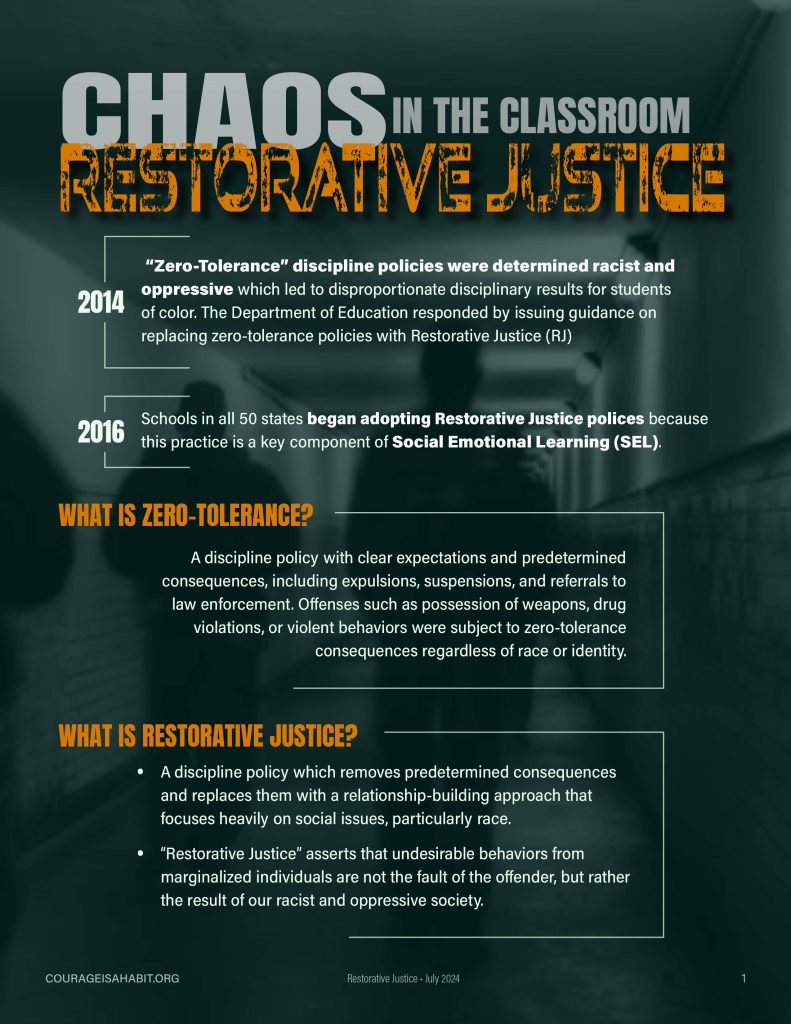
2014: The U.S. Department of Education deemed zero-tolerance discipline policies racist and oppressive, citing their disproportionate impact on black and brown students, often resulting in higher rates of suspensions, expulsions, and disciplinary referrals. In an attempt to rectify these disparities, the Department issued guidance to replace zero-tolerance policies with Restorative Justice (RJ) approaches.
2016: Schools in all 50 states began adopting Restorative Justice policies because it is a cornerstone of Social Emotional Learning (SEL). Instead of creating safer environments as promised, our schools are more violent and chaotic than ever.
Only 17% of voters say schools are doing a good job at enforcing student behavior policies.
What is Zero-Tolerance?
Zero-tolerance discipline policies are characterized by clear expectations and predetermined consequences for specific offenses such as possession of firearms or other weapons, drug violations, and violent behaviors. These policies often led to expulsions, suspensions, and referrals to law enforcement. Though criticized for their harshness, zero-tolerance policies maintained order and safety within schools.
What is Restorative Justice?
Restorative Justice replaced zero-tolerance policies with a relationship-building approach that emphasizes social justice issues: race, sex, climate change, and economic factors.
RJ proponents argue that undesirable behaviors from marginalized individuals are not the fault of the offenders themselves, but rather a consequence of a racist and oppressive American society. They claim that RJ policies will foster understanding and rehabilitation. Unfortunately, this approach has achieved the exact opposite effect, leading to increased disorder and compromised safety in the classroom for students and teachers alike.
Instigating Disorder: The Restorative Justice Process
Restorative Justice involves several key steps that have ultimately led to increased disorder in schools:
Accountability for All: When disruptive behaviors occur, the entire class is held accountable. Instead of disciplining the perpetrator, all students are involved in correcting the behavior through mental health brainwashing interventions or “community circles”, which are intended to build collective responsibility. These sessions are reminiscent of Mao Zedong’s “struggle sessions” during the Chinese Communist Revolution.
These sessions train students to prioritize the radical desires of the collective over what is best for the individual.
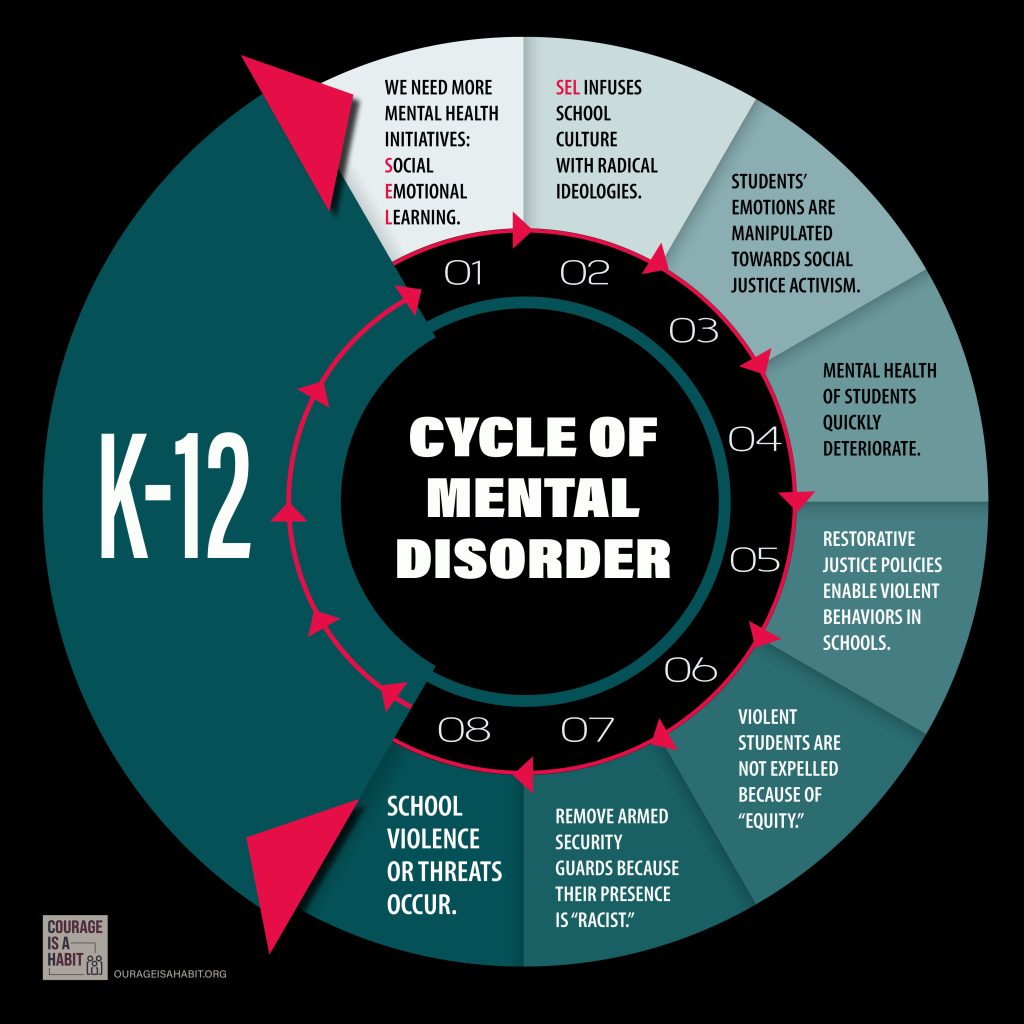
Continuing the Mental Health Scam : Social Emotional Learning uses ongoing lessons, discussions, and counseling to reinforce the belief that society is responsible for the undesired behaviors of marginalized individuals. These interventions aim to reshape students’ perspectives and foster a critical race theory, anti-American viewpoint.
Data Collection: Schools collect data through surveys, assignments, and other means to monitor the effectiveness of the RJ process. This analysis determines whether students are showing empathy towards those exhibiting violent behaviors and accepting their role in oppression by analyzing their own “unconscious biases”.
The Consequences of Removing Consequences
1. Chaos in the Classroom: By not removing disruptive students, RJ has created chaos in the classroom. Students who misbehave with consistent outbursts, including violent episodes, remain in the classroom. This disrupts learning, causes anxiety and fear among other students, and diverts the teacher’s attention to managing misbehavior.
2. Dire Consequences: The tragic mass shooting on February 14, 2018, at Marjory Stoneman Douglas High School in Parkland, FL, highlighted the dangers of leniency policies. The school was participating in the “Promise Program”, a Restorative Justice pilot program. The disciplinary changes removed necessary consequences for the shooter’s prior conduct, allowing him to slip through the cracks and ultimately enabling the tragedy and loss of precious lives. (See “ Why Meadow Died”, by Andrew Pollack)
3. Teacher Shortage: Despite claims by teachers’ unions that low compensation is driving teachers out of the profession, the reality is teachers are leaving in droves due to the lack of effective disciplinary policies. Teachers report feeling unsafe, unsupported, and stressed due to RJ policies. The inability to maintain order and safety in the classroom is a significant factor in the current teacher shortage.

Oakland, CA – 10 Years of Restorative Justice
Since Restorative Justice policies abandons personal accountability (consequences) and replaces it with pseudoscience therapy, schools are not required to report the actual number of disciplinary occurrences.
Why wouldn’t they want to provide accurate reporting of discipline violations at school? Because it would show unequivocally that RJ is doing way more harm than good.
The Oakland School District in California was one of the first to replace zero-tolerance with RJ discipline policies. In 2014, when the Department of Education chose to roll out this policy change for all government K-12 schools, they used Oakland as the model of how RJ will make society a better and safer place for all.
In 2019, West Ed released a report on the implementation of RJ in schools nationwide. The report uses Oakland Schools as an example of achievement 28 times in the report. It states that:
1) “…implementing RJ in Oakland found that 11 out of 12 of the surveyed principals and assistant principals believed that RJ had helped reduce disciplinary referrals for Black and Latino boys”.
2) “In Oakland, Cole Middle School experienced an 87-percent drop in suspensions across the first two years of implementation, compared to the prior three years, and expulsions were eliminated entirely after RJ was put in place.”
If these claims were true, wouldn’t Oakland, CA be a safer place today? After all, cultivating a capable, worthy, and productive society WAS the entire point of implementing Restorative Justice policies.
Here is Oakland, CA on July 17, 2024:
Assassination Attempt of President Donald Trump
On July 13, 2024, a 20-year-old attempted to assassinate President Trump during his campaign rally. In 2019, the shooter threatened to shoot up his high school and put bombs in the bathroom. The school district did not take it seriously and the shooter remained in the school system.
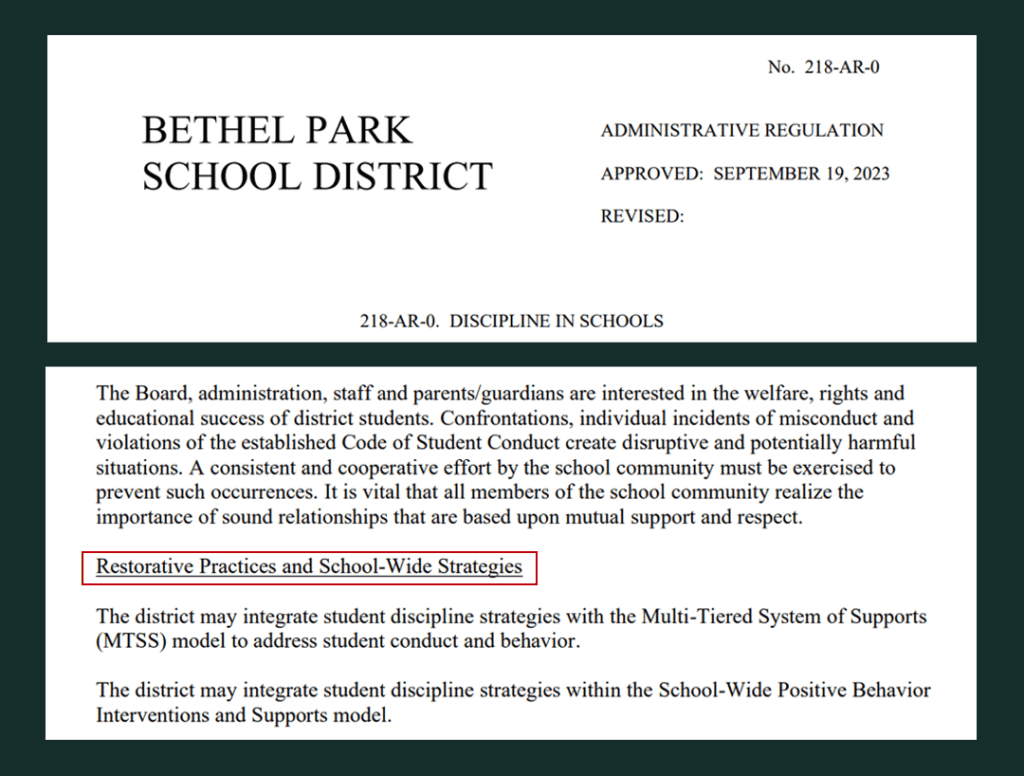
He attended Bethel Park School District, which began to implement Restorative Justice policies in 2017. Here is their updated RJ policy.

Replacing zero-tolerance policies with Restorative Justice was an intentional assault on dismantling our government K-12 system. Instead of creating safer, more high-achieving school environments, RJ has led to increased violence, chaos, and a decline in overall school safety. Our schools are now more dangerous and less effective at maintaining discipline. It is imperative that we re-evaluate our approach to school discipline and focus on individual behaviors and not through the lens of diversity, inclusion, equity (DIE).